
You put a researcher, developer, reviewer, and security agent in the same conversation. All are intelligent. Five minutes later, two have done the same task, the reviewer checked the wrong version, and nobody knows who should end the work.
Congratulations: you did not create a team. You created a corporate group chat running at machine speed.
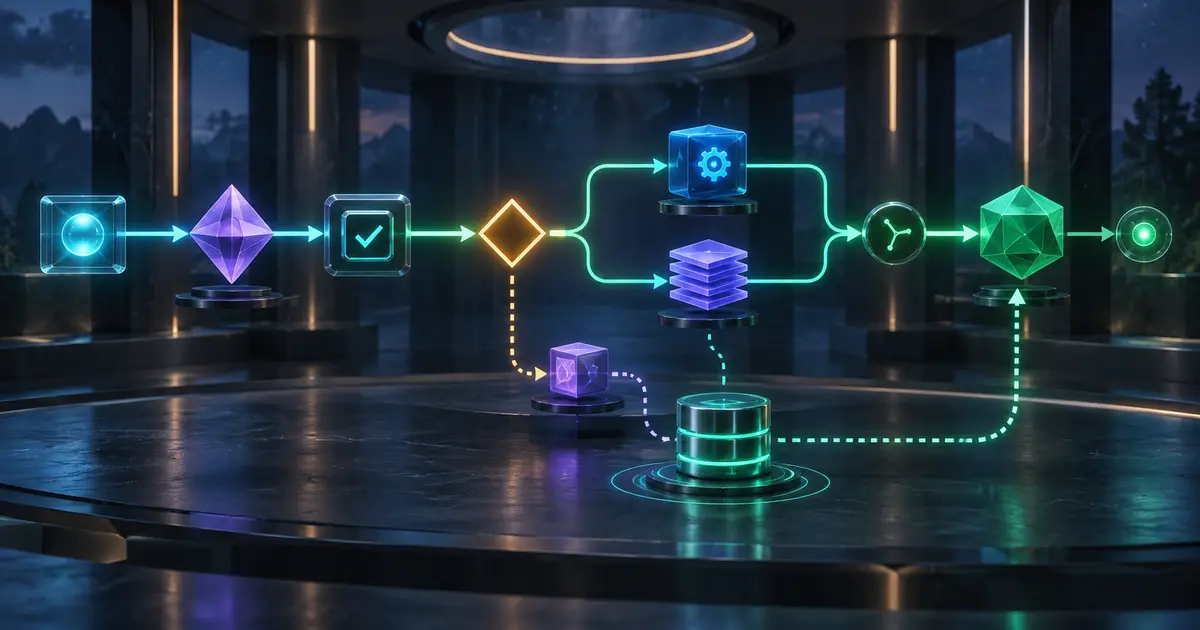
Graph Engineering is emerging as a way to organize this chaos. The idea is to represent tasks, agents, and state as explicit graphs that can be executed, observed, and changed.
First: this is an emerging term
The preprint Graph Engineering in the Era of LLM Agents, published in August 2026, presents the concept as a step after Prompt, Context, Harness, and Loop Engineering. Its authors argue that complex tasks exceed the organizational capacity of one agent and require “system intelligence.”
It is a useful and very recent formulation. The paper has not been peer reviewed, and there is no universally accepted definition of Graph Engineering today. Frameworks executed graph workflows before the term received a spotlight. We should therefore treat it as a paradigm in formation, not the new periodic table.
Do not confuse it with Knowledge Graphs or GraphRAG. Those represent knowledge and relationships among data. Graph Engineering here mainly represents how the system works: who executes, in which order, with what state, and under which conditions.
Three graphs meet
A simple way to understand the concept is to separate three structures:
- task graph: decomposes the goal into dependencies, parallel work, and completion criteria;
- agent graph: connects skills, tools, authorities, and communication channels;
- state graph: records how execution evolves, which evidence exists, and which transitions are allowed.
They may share one implementation, but they represent different decisions. “Review depends on implementation” is a task relationship. “The release agent cannot edit code” is an authority relationship. “Tests failed; return to correction” is a state transition.
When these relationships are hidden in prompts, the model must reinterpret them at every step. When they become executable structure, part of the coordination becomes deterministic.
Nodes do the work; edges choose what happens next
The LangGraph documentation describes three components: state, which holds the current snapshot; nodes, functions that execute logic or effects; and edges, which select the next node. A node can use an LLM, call a tool, or simply run traditional code — good news for anyone who still enjoys an if statement.
Consider a software-change flow:
triage → implementation → tests → review → delivery
That is only a chain. A graph appears when reality arrives:
- security and architecture review in parallel;
- a failed test returns to implementation;
- high risk requires human approval;
- three failures terminate with a report;
- delivery happens only after every piece of evidence arrives.
Microsoft AutoGen provides GraphFlow for sequences, parallelism, conditions, and loops. Its documentation marks the feature as experimental and recommends graphs when strict order or branching is required; a simpler team may be enough for ad hoc conversation.
Google ADK follows similar reasoning. Its traditional workflow agents execute sequences, parallelism, and loops predictably, without asking the model to orchestrate each step. ADK 2.0 added graph and dynamic workflows for more flexible structures.
The practical consensus is clear even if the label is new: use the model where judgment is needed; use structure where the rule is already known.
An edge is part of the product too
Teams often focus on nodes — the researcher's prompt, the developer's model, the reviewer's tool — and treat edges as decorative arrows. Many incidents live precisely in those arrows.
A well-designed edge must answer:
- which event releases the transition?
- which data crosses the boundary?
- is there a schema and validation?
- can the operation be repeated safely?
- what are the timeout and retry policy?
- who chooses among success, correction, and escalation?
- how do we prove the previous node really finished?
If “reviewer approved” is free-form text, the next node may mistake enthusiasm for evidence. A structured result containing status, findings, artifact version, and observed tests makes the transition auditable.
Shared state: the communal refrigerator
Several agents writing into the same state resemble a shared refrigerator: without a name, date, and rule, someone will consume the wrong thing.
Define ownership and update strategy. Does a node replace a field, append an event, or create a new version? Can parallel results be joined? Should temporary information survive a checkpoint? May sensitive data appear in a trace?
LangGraph uses reducers to control state updates and offers checkpointers and breakpoints. Regardless of library, the essentials include typed input/output schemas, artifact identity and version, immutable audit history, a materialized current view, explicit conflict and join policies, and separation between persistent and ephemeral data.
Without them, the graph looks impressive in a presentation and mysterious in production — a traditionally expensive combination.
Loops must know when to stop
A generate → review → correct cycle looks elegant. But what happens when the reviewer finds the same issue for the fifth time?
Every loop needs an exit condition, a budget, and measurable progress. Stop when tests and policies pass; return only for new findings; limit automatic corrections; escalate as risk rises or confidence falls; preserve the best known artifact before terminating.
The graph must allow terminal failure. Forcing every route toward “success” does not improve reliability; it merely teaches the system to call exhaustion completion.
When a graph is worth the complexity
Use explicit structure for important dependencies, parallel execution, approvals, resumability, external effects, or audit requirements. Release processes, regulated support, technical investigations, and data pipelines are natural candidates.
Do not build a cathedral of nodes to answer a simple question. One tool-enabled call may solve it. A short chain may be enough. Even the best map gets in the way when you only need to cross the street.
| Need | Starting structure |
|---|---|
| isolated question or action | single agent |
| stable ordered stages | deterministic chain or workflow |
| branching, parallelism, and retries | execution graph |
| dynamic composition of teams and tasks | Graph Engineering with strong governance |
Start with few nodes and named transitions. Instrument duration, cost, failures, retries, and human intervention for each edge. Add dynamism only when it solves an observed variation, not because the diagram has empty space.
The main point
Graph Engineering is not “adding more agents.” It is designing the topology that turns different capabilities into a coherent system: explicit tasks, bounded roles, versioned state, verifiable transitions, and loops with exits.
The term may change as the field matures. The problem will not: individual intelligence does not automatically organize collective work. Even advanced agents need to know who does what, which version counts, and who may finally press the button that ends the meeting.
References
- Feng et al. Graph Engineering in the Era of LLM Agents, preprint, 2026.
- LangChain. LangGraph Graph API overview, accessed September 2026.
- Microsoft. AutoGen GraphFlow, accessed September 2026.
- Google. Agent Development Kit — workflow agents, accessed September 2026.
- Sakhinana and Runkana. Towards Agentic Cloud Engineering, preprint, 2026.