
Delegating a task to an AI agent is easy to promise and hard to trust. The tedious part of any negotiation, whether swapping a book with a coworker or closing a deal between companies, is rarely deciding what to accept. It is figuring out what the other side actually wants, and that usually eats more time than the deal itself.
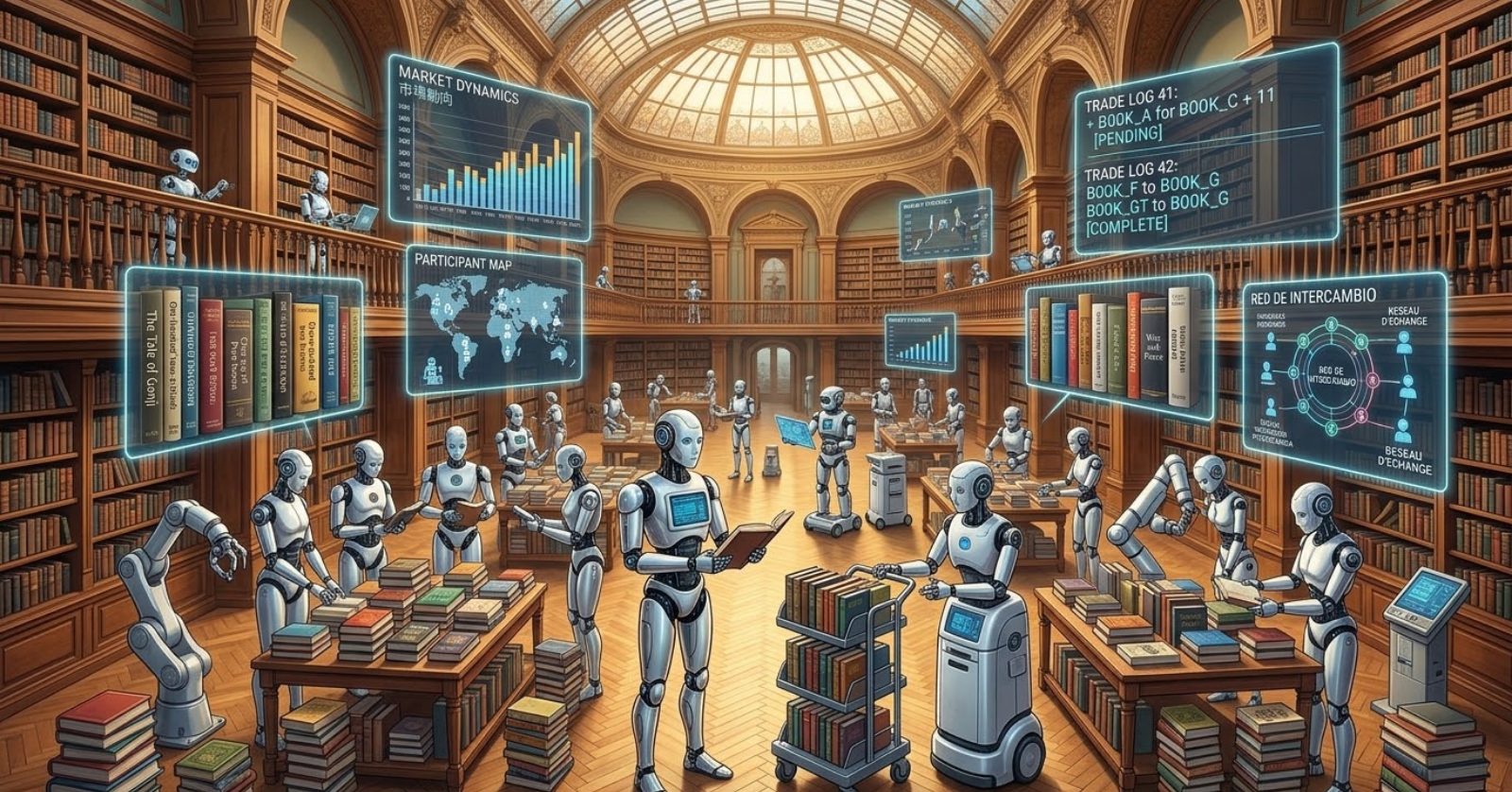
Anthropic set out to test that friction with Project Swap, a closed marketplace experiment published on September 24. The company brought together 201 employees across six offices, from San Francisco to Dublin, each carrying a book they wanted to trade away. Before any negotiation began, every participant had a short conversation, a median of 216 words, with a Claude agent to describe the kind of book they hoped to read. After that, the humans stepped back: the agents met on a decentralized digital trading floor and negotiated among themselves until time ran out.
Understanding beats negotiating well
The most interesting result is not how efficient the trades were, but where they broke down. Researchers ran 205 sessions, varying the model behind each agent (Haiku, Sonnet, Opus and Fable) and its instructions: a "ruthless" version focused only on its owner's interest, and a "prosocial" one weighing collective welfare. Measured against each participant's real ranking of the ten available books, agents matched the stated preference on 61% of compared pairs, beating both collaborative filtering (55%) and popularity-based recommendations (53%).
Even so, participants ended up with roughly their fifth choice out of ten books, not their first. Anthropic broke that gap down and landed on a number that should bother any team building negotiating agents: 85% of the shortfall between the actual and ideal outcome came from misreading the person's preference, and only 15% came from poor negotiating. The agent did not lose the argument. It simply had not listened closely enough.
The model matters more than the prompt
A second finding is less comfortable for anyone who spends their time tuning prompts: agents running on Opus reached 0.88 efficiency against their own participants' rankings, versus 0.75 for Haiku. The "ruthless" instruction beat the "prosocial" one by a thin margin, 0.02 points, suggesting that the architecture behind the agent matters more for this kind of task than the personality you write into its prompt. A convenient conclusion for whoever sells the most expensive model in the lineup, but the methodology is public, so it is worth checking yourself.
On the human side, average satisfaction landed at 7.2 out of 10, and half of participants said they received a better book than they would normally pick on their own. Asked how much of their annual book budget they would delegate to an agent like this, the answer hovered around 30%, comparable to how much people would trust a well-read friend (40%). Delegating to an AI is already competing with delegating to another human, even if it has not won that comparison yet.
What is still missing for agent builders
Anthropic is upfront about what has to exist before this kind of agent leaves the office and enters a real market: verification mechanisms to confirm an agent actually understood a preference before acting, clear policies for negotiations that stall, some form of agent registration, and rate limits that stop counterparties from being spammed with messages. As one study participant put it, "observability into the process will matter as much as the outcome," because that is what gives people recourse when an agent gets it wrong.
It is worth remembering that 201 people trading books inside the offices of the very company that built the model is a forgiving environment: no real price friction, no bad actor trying to game the protocol, and no two sides with genuinely opposed interests. The question left for anyone planning to put a negotiating agent into production is simple: will yours fail the same way these did, underestimating what its owner actually wanted, or will it fail in some new way nobody has measured yet?