
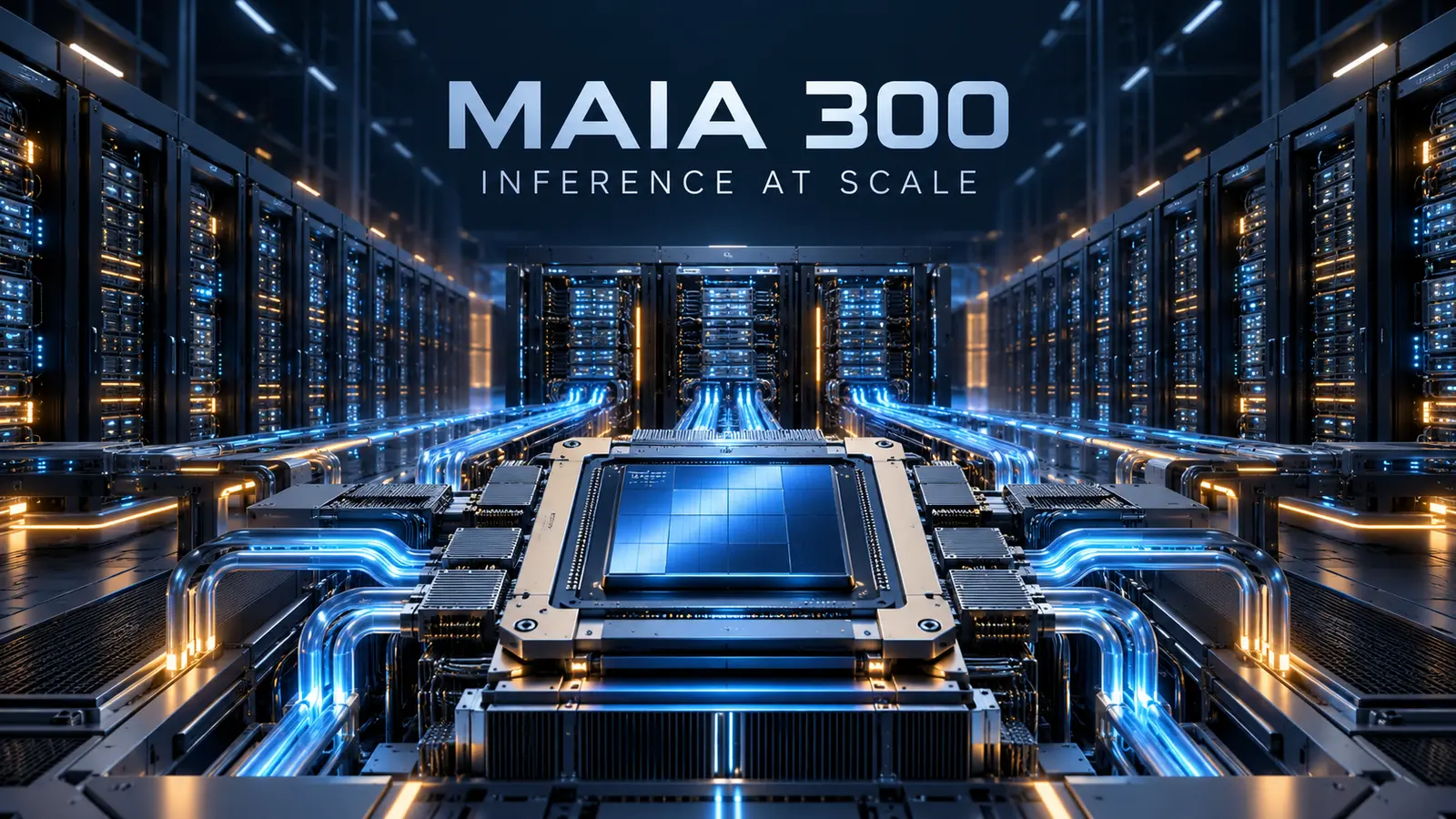
For years, the AI race has been narrated through model size and GPU purchases. Maia 300, introduced by Microsoft on October 12, shifts attention to a less glamorous question that lands directly on the power bill: how many useful tokens can a data center deliver from each megawatt?
The new accelerator is built for inference, the stage where a trained model responds, reasons and uses tools. Production deployments are due to begin in 2027 as Azure Maia expands to multigigawatt scale. Microsoft intends to make the family its primary inference platform for internal products and services.
That does not make Maia 300 a customer order today. The announcement lays out a future deployment plan and gives no price, region or commercial access model for Azure customers.
The system matters more than the isolated chip
The architecture is more revealing than a single peak specification. Each accelerator combines 288 GB of HBM4 memory and 18 TB per second of bandwidth within a projected 950 watt thermal envelope. A full rack connects 96 accelerators, 27.6 TB of memory and 1.7 PB per second of aggregate bandwidth while drawing 167 kilowatts.
Those figures address a familiar inference bottleneck: moving data can consume more time and energy than performing the mathematical operation. Microsoft's Maia 300 architecture deep dive describes software controlled dataflow, locality aware memory and Ethernet based networking that can link up to 12,288 accelerators in one superpod.
This is a full stack engineering bet. Silicon, memory, networking, cooling and software are designed as one platform. For long context reasoning, tool use and multistep work, the aim is to keep data close to the unit that needs it and reduce unnecessary trips across the system.
The competition is not only about adding compute. It is about wasting less energy and moving less data for every useful answer.
Performance claims still need context
Microsoft says Maia 300 delivers 40% more tokens per megawatt than leading GPU based systems. In a 96 accelerator rack, it claims up to seven times Maia 200's token throughput and more than 2.5 times its performance per watt.
These are vendor comparisons. Microsoft has not publicly named the systems behind the 40% baseline or supplied the model mix, numerical precision, batch size, latency and utilization conditions needed to reproduce it. The number indicates the design goal, but it is not yet an independently verifiable advantage.
Scale requires similar care. Reuters reported that Microsoft could deploy more than one million units in 2027. The official announcement confirms multigigawatt deployments, but does not set that chip count as a public commitment.
Why agent builders should pay attention
Agents stress infrastructure differently from a short chat. They preserve context, call tools, wait for results and return to the model repeatedly. The real cost emerges from the completed task, not from one response.
Owning both silicon and software gives Microsoft room to tune Maia around patterns it observes in Copilot, GitHub Copilot, Foundry and its own models. It also reduces the need to depend on an external architecture for every product optimization. The tradeoff is flexibility: a deeply integrated platform must keep up with workloads that evolve faster than silicon development cycles.
The meaningful test in 2027 will be less cinematic than a chip render. Watch sustained throughput, latency, availability, cost per completed task and compatibility across models. If Maia 300 improves all five in production, Microsoft will have built more than an accelerator. It will have turned its own AI operations into a product advantage.
Sources: Microsoft's official announcement, architecture deep dive, media microsite and Reuters coverage.