
When an agent opens files, runs code, queries a database and calls a model, only part of that path is inference. Yet AI infrastructure is often presented as if the entire workload belonged on the same kind of accelerator.
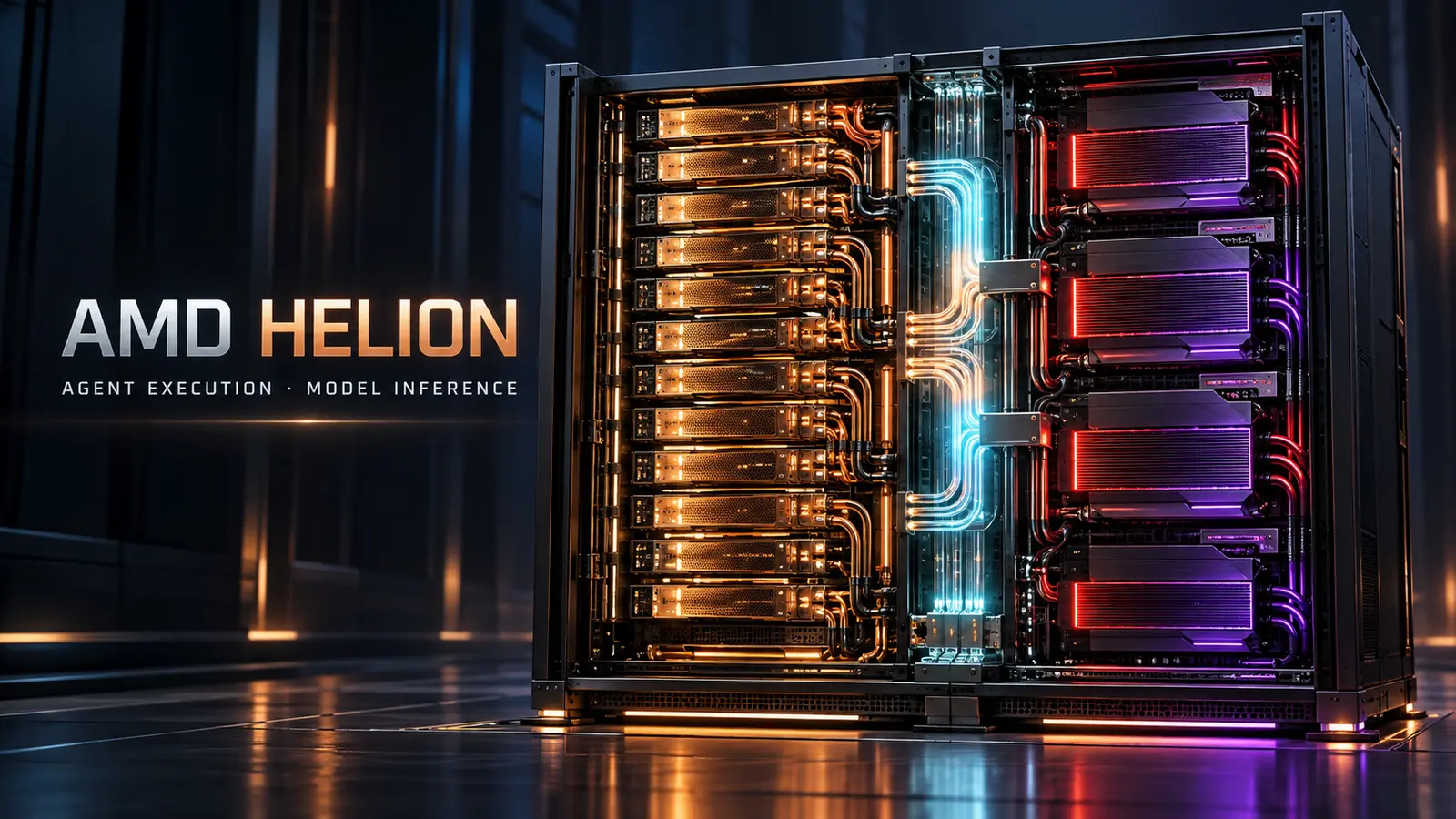
AMD made that distinction the organizing idea behind Helion, introduced on October 12. The rack reference design comes in a CPU-only configuration connected to separate inference infrastructure, and an integrated version that places CPUs, GPUs and general-purpose compute in one rack. It is based on Open Compute Project specifications, and AMD says it plans to contribute the design to OCP.
The useful idea is not that agents can do without GPUs. It is that running an agent and running its model are different jobs.
Two compute planes, one agent system
The hyperscale configuration uses sixth-generation EPYC processors and, according to AMD's published specification, can scale to 32,768 CPU cores. Those racks execute agents while sending model calls to a separate inference layer. The premise is that large providers already operate shared accelerated infrastructure and can size orchestration work independently.
For enterprises that do not want to run two environments, the second configuration combines EPYC CPU blades, up to 16 Instinct MI350P GPUs, and servers for databases, storage and technical computing. An integrated token router can direct inference requests to frontier models in the cloud or open models running locally.
That split makes it easier to see where time and money go in an agentic workflow:
- the model interprets, plans and generates outputs;
- the execution layer calls tools, processes data and keeps concurrent tasks moving;
- supporting services provide state, storage, networking and observability.
These stages interact, but they do not have identical memory, parallelism or latency profiles. Putting everything on GPUs can waste expensive capacity. Putting everything on CPUs can make inference the bottleneck. Architecture begins at the boundary between the two.
An open blueprint is not proven performance
There are important limits. AMD's figures are maximum specifications for a reference architecture, not independent measurements of throughput, cost per task or energy per agent. Partner configurations remain under development and are planned for November 2026. AMD itself classifies performance, timing and expected benefits as forward-looking statements.
There is also no “average agent” that settles capacity planning. A personal assistant that spends much of its time waiting for APIs, a coding agent compiling large projects, and a technical automation running compute-heavy tools will stress the rack differently. Helion's documentation lists dense, balanced and high-frequency CPU blades because the mix is workload-dependent.
That makes this a different infrastructure question from the recent NVIDIA Vera Rubin and DSX announcement or Microsoft Maia 300. Those systems address acceleration and AI infrastructure at different scales. Helion focuses on the rack composition around model inference.
For AI Engineering teams, the practical question is not “how many agents fit in a rack?” Three measurements come first: how much time the workflow spends in the model, how much compute it consumes while using tools, and how long it waits on networks or external services. Without that profile, “agentic infrastructure” is just a new label on the data center.
Helion still has to demonstrate its value in production deployments. But the design captures a useful shift: the model may be the most visible part of an agent, yet it does not have to define the entire machine.
Sources: AMD Helion announcement and the product specifications and FAQ.