
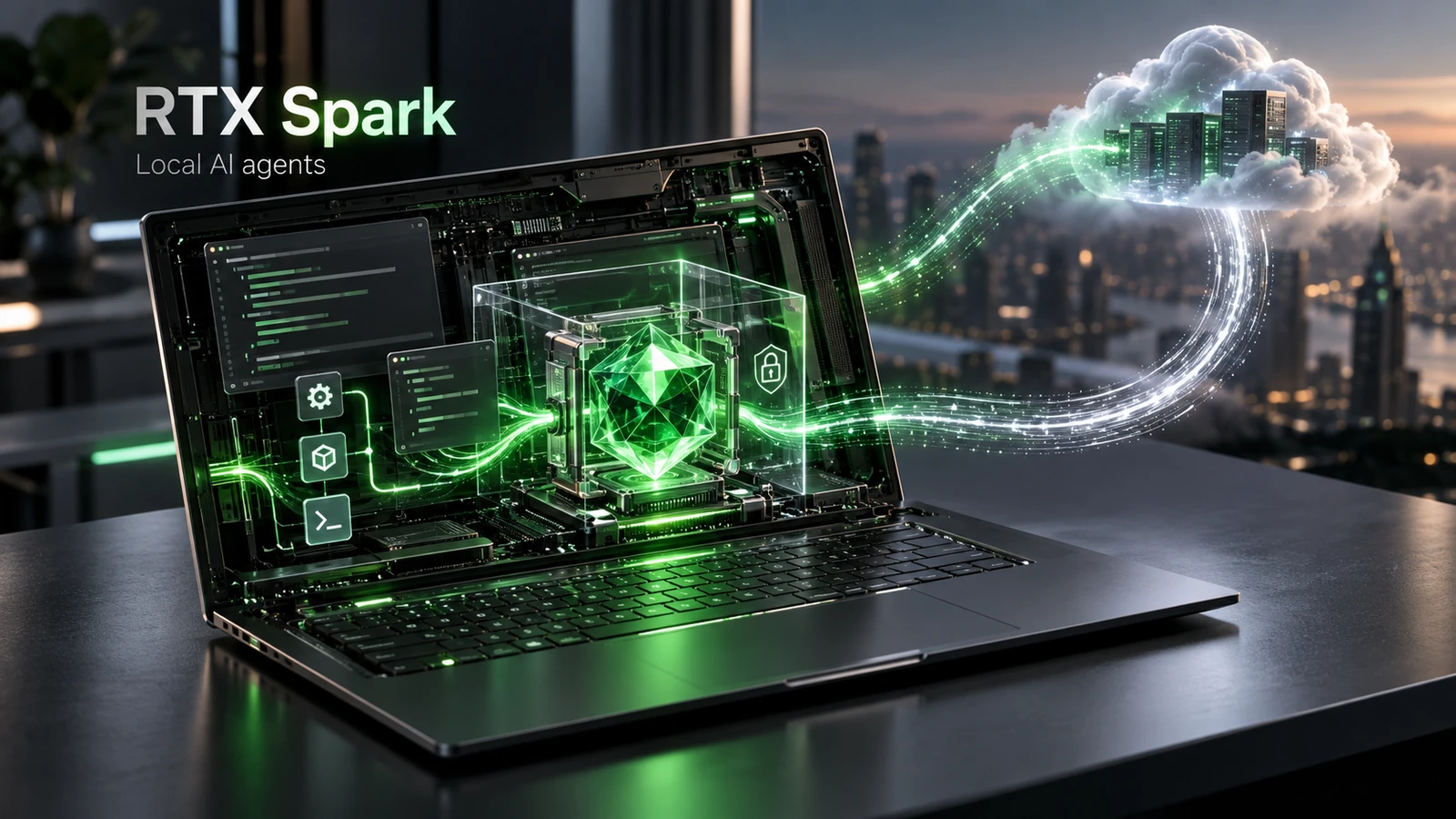
Running an AI agent on a laptop appears to answer two concerns at once: keep data close and reduce cloud calls. The harder problem starts when that agent opens files, invokes the terminal and installs dependencies. Memory and speed no longer settle the question. The PC has to become a controlled execution environment.
That is the transition NVIDIA is pitching with RTX Spark laptops, announced October 13 and scheduled to reach the market October 16. The company says the systems will offer up to 128GB of unified memory and 1 petaflop of AI compute. Those are vendor specifications and claims; the primary announcement does not provide independent measurements of performance, battery life or thermals under real workloads.
The more consequential change is not merely fitting a large model on a laptop. It is connecting models, tools, isolation and routing in one local environment.
The PC becomes part of the agent architecture
NVIDIA says applications including GitHub Copilot, Hermes, OpenClaw, Perplexity, Pi and WorkBuddy are integrating with RTX Spark. The design lets an application run models locally and reach the cloud when a task requires different capabilities. Switchyard, an open source model router, is intended to support some of that choice between local and remote execution; several integrations are only promised for later in October.
PAIR, NVIDIA's software that left beta on October 13, extends the idea across devices. It discovers compatible machines on a network and distributes inference requests across Windows, Linux and macOS. Its documentation states a useful boundary: the computers remain separate systems processing parallel tasks. PAIR does not combine their GPUs into one virtual GPU.
This reframes an architecture decision. Teams have to decide where each request runs, which data may leave the network and what happens when a local node is busy. Privacy depends on that policy. An application with a silent cloud fallback still needs a data inventory, logging and access controls.
Sandboxing sits on the critical path
Local agents are not safe simply because they are local. They can read credentials, modify repositories and execute malicious code received through a dependency or an instruction. NVIDIA is addressing that risk by pairing OpenShell with Microsoft Execution Containers, or MXC. The company says GitHub Copilot and OpenClaw can use those containers to isolate commands, protect credentials and monitor execution.
That is a useful direction, not a universal assurance. The announcement covers specific integrations on different schedules. It does not establish that every action by every agent crosses the same trust boundary, nor does it publish independent results for sandbox escapes or indirect prompt injection.
MnzAI Labs' assessment is that a responsible pilot should inspect three boundaries:
- which files, secrets and devices the agent can access;
- when a task leaves the PC and which provider receives it;
- how commands, approvals and failures are recorded for audit.
Without those answers, “local” describes where the model runs, not the system's risk level.
Compatibility and model quality remain open tests
The software package also targets a practical Windows on Arm problem. NVIDIA announced what it calls the first PyTorch-CUDA build for the platform, native Python 3.15 and a Conda installer. The company says 97% of the top 15,000 Python wheels are ready, but the article does not provide the full list or the counting method. Teams that depend on native libraries, internal extensions or older packages still need to validate their own projects.
On the model side, Nemotron 3.5 Bolt 74B-A9B is scheduled for October 15. NVIDIA says the model will occupy 24GB, activate 9 billion parameters per request and ship with open weights, training data and recipes. Because the announcement precedes availability, its license, artifacts and benchmarks still need to be verified after release.
RTX Spark arrives with a plausible thesis: personal agents can use a PC as infrastructure, keeping more context on the local network and calling the cloud selectively. The real evaluation begins after commercial launch. A useful pilot should measure task quality, latency, tool compatibility, routing behavior and credential isolation. If one of those elements fails, abundant memory becomes a comfortable specification for an incomplete system.
Sources: NVIDIA's RTX Spark announcement, PAIR documentation and 1.0 release notes and GitHub's view of routing across models.